
Your workshop teaches the model.
The Lab is what makes it stick.
The Practice Lab is built for trainers running cohort-based motivational interviewing programmes. Run a pilot with your next cohort. Your trainees practise between sessions, share their work with you, and arrive at the next workshop with sharper questions.
You teach. They drift.
Every MI trainer knows the pattern. A great workshop. Real progress in the room. Then weeks pass, and without practice, the OARS fluency softens, the change-talk reflex fades, and the spirit goes back to whatever the trainee did before they met you.
Miller & Mount (2001) measured it. Madson and Schwalbe replicated it. Without ongoing practice and feedback, MI skills decline within months. The Practice Lab is the practice-and-feedback piece, built so it actually fits in a clinician's week and sits alongside their CPD or CEU requirements.
~3-4mo
Typical window in which workshop-only MI gains are observed to decline without follow-up practice.
Built for the way you actually train
Three things make the Lab work as a between-workshop practice tool.
Detailed feedback against specific moments
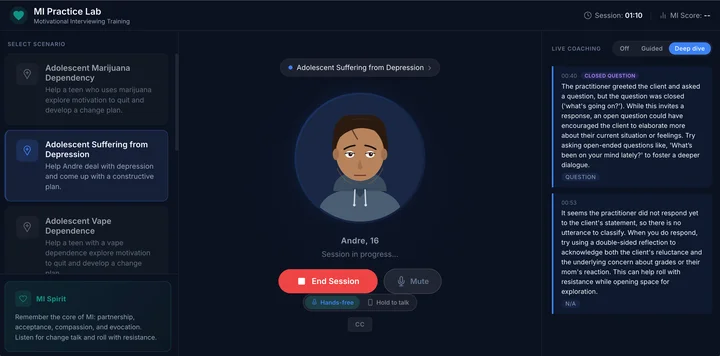
Trainees finish a session and tap "share with coach". You receive the full transcript and audio recording, plus an interface to leave feedback inline, anchored to specific timestamps in the conversation.
No more scheduling supervision calls just to discuss one reflection. Leave nuanced feedback when it suits you, and trainees absorb it in context.
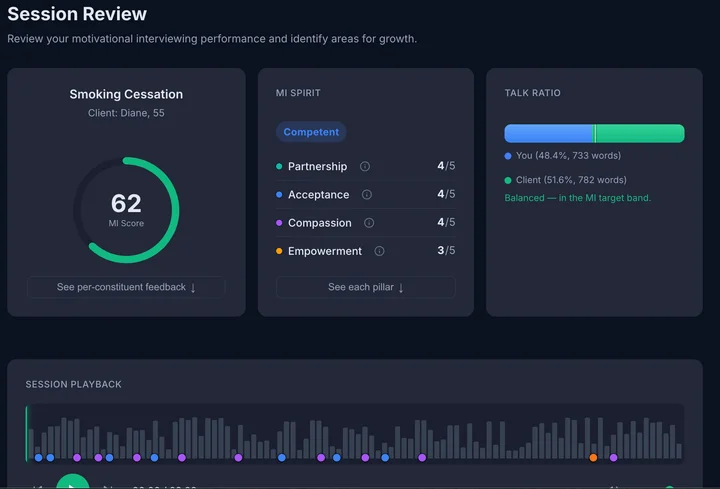
OARS, MI Spirit, EFEP: measured per session
Every session ends with a structured review: MI Score, MI Spirit broken across the four pillars, Talk Ratio, and an OARS-tagged playback timeline.
Use it as common ground in supervision. Trainees come ready with what they noticed; you come ready with what to coach next. The counts are modelled on MITI's structure, so they read the way your fidelity feedback already does. It is formative practice feedback, not a credentialing assessment.
Scenarios that match your practice setting
Generic scenarios are fine for week one. By week three, your cohort needs scenarios that look like the clients they actually see: substance-use settings, primary care, paediatric mental health, social work, whatever the cohort is heading into.
We build custom scenarios for cohort pilots: real presenting concerns, realistic ambivalence patterns, and the rough edges that make practice useful.
Existing scenarios include
- · Adolescent substance use (marijuana, vape)
- · Adolescent depression
- · Smoking cessation
- · Weight management
- · Medication adherence
- · Plus bespoke scenarios for cohort pilots
What trainers in our pilot cohorts are saying
Her son walked in, heard the conversation, and quietly walked back out. He thought she was talking to a real patient.
This is the future of MI training.
Trainer FAQ
Who is the cohort pilot for?
What does the pilot include?
How long does a pilot run?
Can I get scenarios built for my specific population?
Will CBT scenarios be available?
What does the MI scoring measure, and how does it relate to MITI?
Tell us about your next cohort
Quick enquiry: we'll come back within two working days to scope a pilot. Or if you'd rather skip straight to a 20-minute call, the Calendly link works.