
Keep MI skills alive
between workshops
A realistic AI client, structured MI feedback, and a "share with coach" handoff that turns every session into a teachable moment. Built to extend the workshop, not replace it.
The MI Practice Lab in 56 seconds Transcript
Diane: I know I should stop smoking. But honestly... it's what keeps me going.
Narrator: What would you say next?
You care about getting it right, but without practice, skills fade, and real clients aren't the place to rehearse. The MI Practice Lab is.
Talk out loud with realistic AI clients and get live coaching as you go. Afterwards, see every moment mapped: your OARS, your MI Score, your MI Spirit. Share it with your trainer for feedback on the moments that matter. And when a moment doesn't land, practise it again.
On screen, the reply is written as a reflection: "It helps you cope... and part of you wants to stop."
Diane: Yeah, part of me really does.
Narrator: Real conversations, specific feedback, skills that stay sharp. The MI Practice Lab from Zenobits.
What is the MI Practice Lab?
The MI Practice Lab is an AI-powered Motivational Interviewing practice tool. Clinicians, social workers, health coaches and counsellors have voice-to-voice conversations with realistic AI clients (adolescent substance use, depression, smoking cessation, weight management) and receive structured MI fidelity feedback after every session: OARS coding, change-talk markers, MI Spirit pillars, a Talk Ratio reading, and evidence quotes pulled from the transcript.
It's purpose-built to complement MI workshops, not replace them, addressing the well-documented finding that MI skills decline within months of an initial workshop without ongoing deliberate practice. Sessions can be shared with a coach or trainer for inline feedback. CBT scenarios are on the roadmap and will live inside the same Lab.
MI skills decay without practice
Decades of research on MI training tells the same story: a two- or three-day workshop produces real gains in MI competency, and those gains erode within months unless practitioners practise.
Miller & Mount (2001) found that workshop-only training produced statistically significant skill gains that did not translate into changes in client outcomes: practitioners said the right things less often than they thought, and stopped saying them shortly after the workshop ended.
Multiple follow-up studies have replicated the finding: without ongoing practice and feedback, MI skills decline. The workshop is the on-ramp. What happens next determines whether the skill survives.
What the research consistently shows
- → Workshops alone are insufficient for sustained MI proficiency.
- → Coaching and structured feedback are the strongest predictors of skill retention.
- → Self-assessed MI skill systematically overestimates measured MI skill.
- → Repeated practice with feedback is what closes the gap.
Miller & Mount (2001); Madson, Loignon & Lane (2009); Schwalbe, Oh & Zweben (2014).
What learners actually do in the Lab
Six things that make the Practice Lab a serious training tool, not a chatbot wrapper.
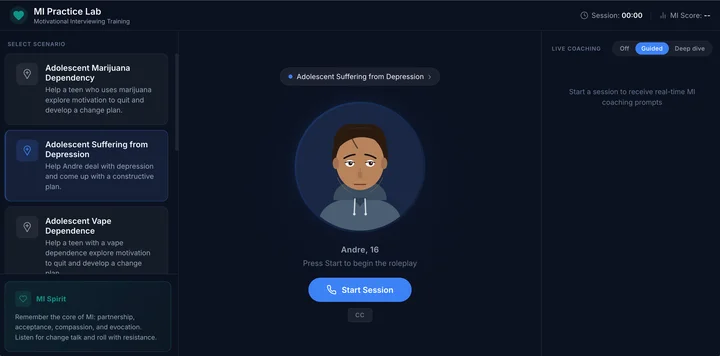
A library of clinically realistic scenarios
Pre-built clients with real clinical concerns (adolescent substance use, depression, smoking cessation, weight management), each with their own ambivalence, history, and willingness to engage. Trainers can also commission bespoke scenarios.
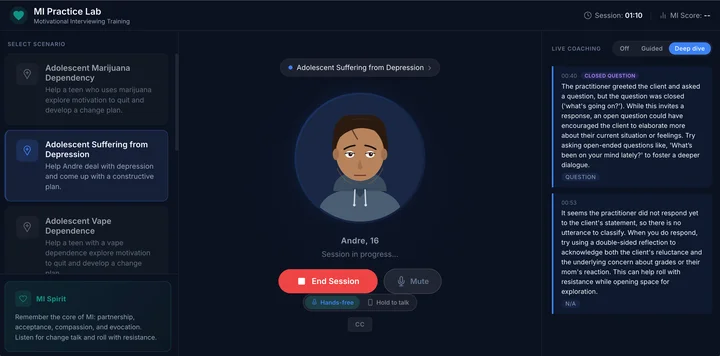
Live coaching while you practise
Toggle Guided or Deep-dive coaching mid-session. As you speak, the Lab flags closed questions, missed change talk, and missed opportunities for reflection, then suggests what to try instead. Or turn it off and run unassisted.
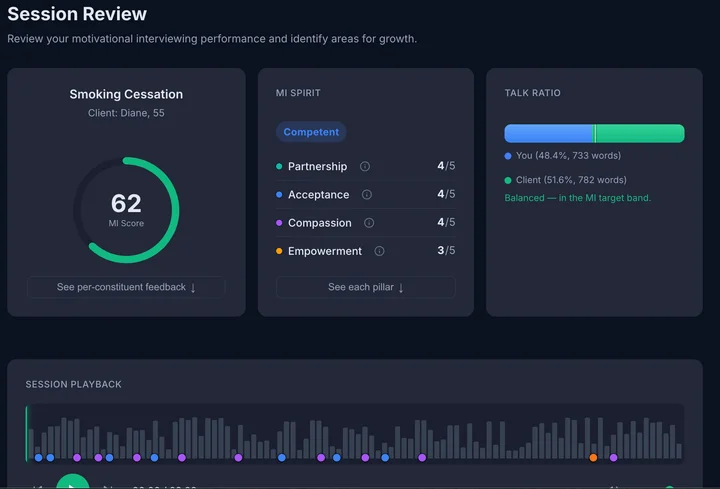
MI Score and MI Spirit, broken down
Every session ends with an MI Score, a balanced Talk Ratio reading, and an MI Spirit breakdown across the four pillars: Partnership, Acceptance, Compassion, Empowerment. Each with its own rubric and per-pillar feedback.
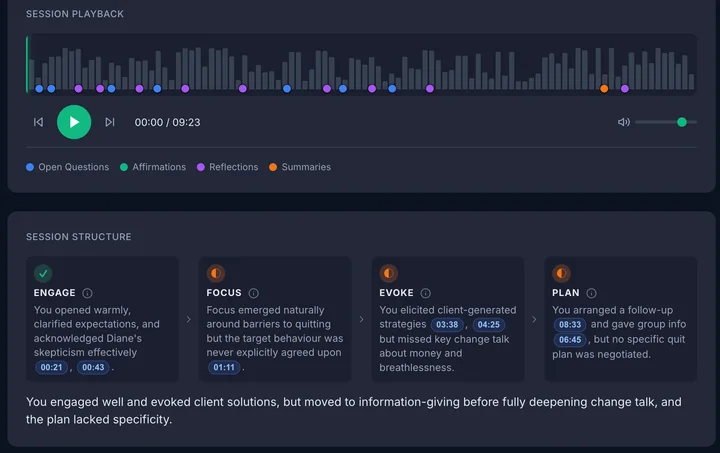
OARS-tagged session playback
Replay the conversation with every Open Question, Affirmation, Reflection and Summary marked on the timeline. The Engage · Focus · Evoke · Plan structure is overlaid so you can see where the session moved, and where it stalled.
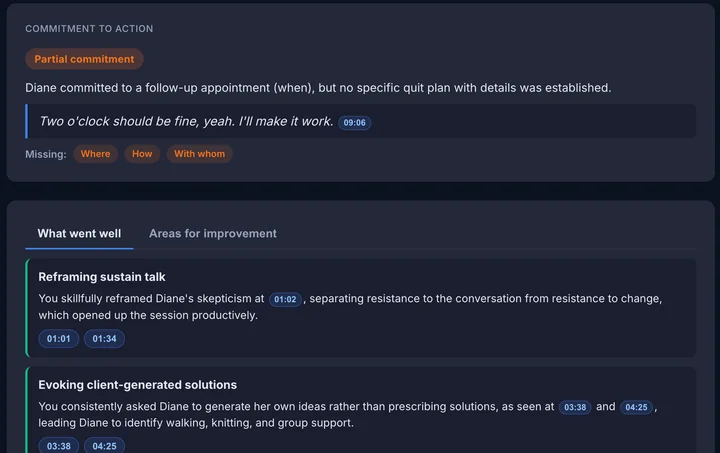
What went well, where to grow
Specific, evidence-anchored feedback citing exact moments in your transcript. Skilful reframes you nailed, sustain talk you missed, and partial commitments that needed pinning down, with timestamps you can jump to.
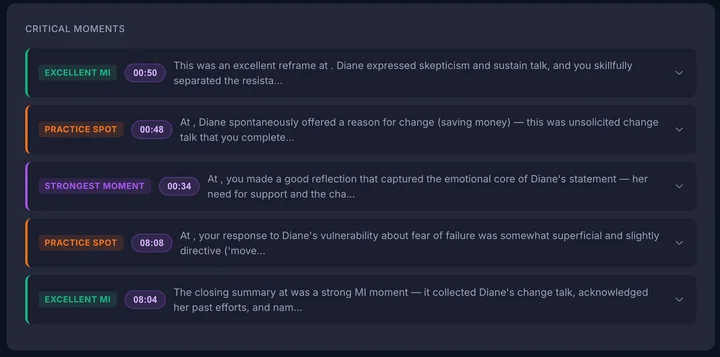
Critical moments worth revisiting
The Lab surfaces three to five pivotal moments per session (Excellent MI, Strongest Moment, Practice Spots), so you don't have to re-listen to the whole conversation to find what mattered.
Share the session with a coach
One tap sends the full transcript and audio recording of a session to a designated coach or trainer. The coach receives an interface to leave detailed feedback inline, anchored to specific moments in the conversation.
That turns the Lab into a structured between-session check-in tool: trainees practise, share, get nuanced human feedback, and bring richer questions to the next workshop session.
See how trainers use thisFull transcript
Time-stamped, OARS-tagged, searchable.
Audio recording
Listen back to tone, pacing, and moments of empathy.
Inline coach feedback
Coaches respond against specific moments, not the whole session in one go.
Is the AI's MI scoring any good?
Early bench testing shows promising alignment between the Lab's MI classification and human MITI-trained coders on core OARS behaviours. The numbers aren't yet at publication-grade. That's deliberate; we'd rather ship caution than overclaim.
A more rigorous evaluation against MITI 4.2.1 is in progress, and we'll publish the methodology and results in full when they're ready. In the meantime, treat the Lab's scores as formative practice feedback, not a credentialing assessment.
What we're testing
- · Agreement with MITI-coded reference sessions
- · OARS classification accuracy (open vs closed questions, simple vs complex reflections)
- · Change-talk vs sustain-talk discrimination
- · Stability across client demographics and presenting concerns
If you're an MI researcher and want to see the methodology in progress, get in touch.
CBT scenarios: same Lab, same coach feedback loop
We're extending the Practice Lab into Cognitive Behavioural Therapy: same interface, same share-with-coach handoff, same session structure adapted for CBT. If you train CBT and want early access, come and talk.
What trainers and clinicians say
Her son walked in, heard the conversation, and quietly walked back out. He thought she was talking to a real patient.
This is the future of MI training.
I feel like this program is the best training I have ever gotten for MI.
Unnamed for now. Named testimonials coming soon.
More on motivational interviewing
Motivational Interviewing: overview
What MI is, who uses it, OARS skills, and why deliberate practice matters.
MI roleplay scripts
Five worked roleplay scripts: diabetes, smoking, substance use, adherence, performance.
For MI trainers
Cohort pilots, share-with-coach, bespoke scenarios for trainers running programmes.
MI fundamentals: practical guides
OARS
Open questions, affirmations, reflections, summaries. Examples and how to practise each.
MI Spirit
Partnership, Acceptance, Compassion, Empowerment: the relational stance under MI.
Change talk & sustain talk
DARN-CAT, evoking change talk, responding to sustain talk without arguing.
MI fidelity & MITI
How MI is measured. Competence vs proficiency thresholds. Using coding for improvement.
Frequently asked questions
Who is the MI Practice Lab for?
How does this complement an MI workshop?
What is the 'share with coach' feature?
Is the AI's MI scoring accurate?
Will there be CBT scenarios?
Can I run this with a cohort?
Two ways to get started
Whether you train MI or you're keeping your own skills sharp, the Lab fits in. Pick the path that matches you.