
Blog AI Roleplay Training: The Complete Guide (2026)
Learn how AI roleplay training works and why it outperforms traditional methods (effect size 0.82). How to build your first scenario in under 10 minutes.
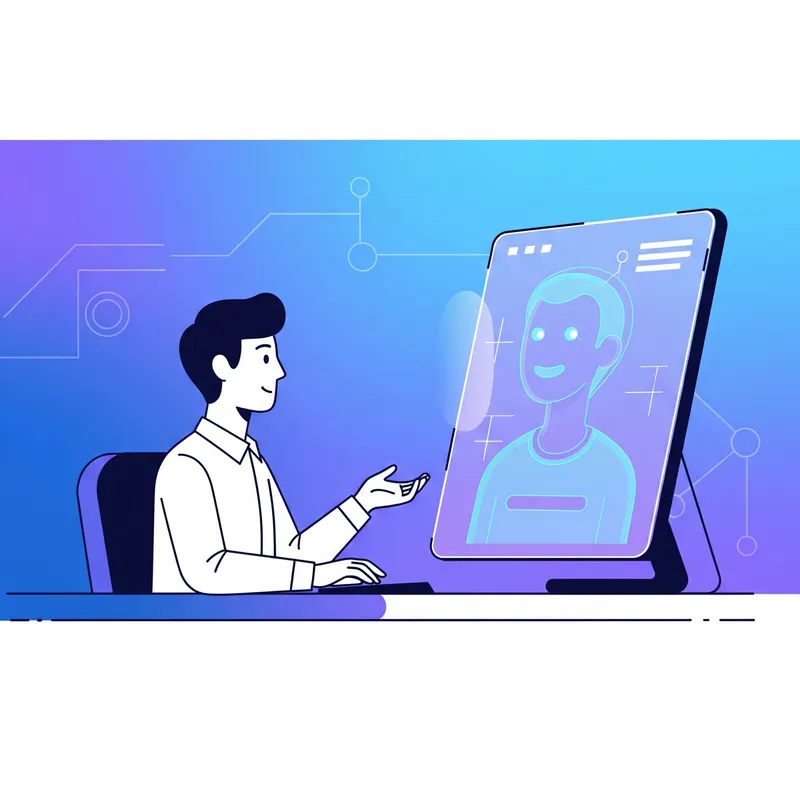
AI roleplay training is a new category of workplace learning where employees practise real conversations with AI characters — customers, clients, new hires, difficult colleagues — instead of passively watching videos or clicking through slides. Some people write it “AI role play training” (two words); the meaning is the same: realistic, conversational practice, powered by AI.
Here’s why it matters. People forget roughly 70% of new information within 24 hours of learning it. After a month, they retain about 20%. This isn’t speculation — it’s the Ebbinghaus forgetting curve, first documented in the 1880s and replicated in 2015 with the same depressing results.
Now think about how most corporate training works. An employee watches a video, clicks through some slides, passes a multiple-choice quiz, and gets a certificate. Two days later, they’ve forgotten most of it. A month later, it might as well have never happened.
AI roleplay training is the opposite of that. Instead of passively consuming content, employees actively practise — having real conversations with AI characters that listen, respond, push back, and give personalised feedback. It’s the difference between reading about how to handle a difficult conversation and actually having one.
What Is AI Roleplay Training?
AI roleplay training uses generative AI to create realistic conversational scenarios that employees can practise with. Think of it as a flight simulator for human skills.
The employee enters a scenario — say, delivering tough feedback to an underperforming team member — and has a real-time conversation with an AI character. The AI plays the role naturally: it reacts to what the employee says, asks follow-up questions, pushes back when appropriate, and sometimes gets emotional or defensive, just like a real person would.
When the conversation ends, the AI evaluates the employee’s performance and delivers detailed feedback: what they did well, what they missed, and specific suggestions for improvement.
This isn’t a chatbot. It’s not a decision-tree where you pick from three pre-written responses. It’s an open, dynamic conversation where the employee has to think on their feet — exactly like the real situation they’re training for.
How It Actually Works
If you’re an L&D professional, instructional designer, or training manager, here’s what the process looks like in practice:
1. Design the Scenario
You write a brief that tells the AI who to play and what to test for. For example:
“You are a customer who received the wrong order. You’re frustrated but reasonable. The learner should acknowledge the issue, apologise sincerely, and offer a specific resolution. Push back if they’re vague or dismissive.”
You also set evaluation criteria — the specific things the AI should assess. Did the employee de-escalate? Did they follow the company’s complaints procedure? Were they empathetic?
2. Employee Practises
The employee opens the scenario and has a voice or text conversation with the AI character. There’s no script to follow, no multiple-choice safety net. They have to listen, think, and respond — just like in a real interaction.
Each session is different. The AI might raise different objections, express different emotions, or take the conversation in unexpected directions. This means employees can’t memorise their way through it. They have to genuinely understand the skill.
3. AI Delivers Feedback
When the conversation ends, the AI generates structured feedback based on the criteria you set. Not just “pass” or “fail” — a detailed breakdown of what worked, what didn’t, and why.
This feedback loop is the most powerful part. In traditional training, employees rarely get feedback on their actual performance. In AI roleplay, every session ends with specific, actionable insights they can use immediately.
4. Repeat and Improve
Because the AI is always available and every conversation is unique, employees can practise as many times as they want. They can experiment with different approaches, test what works, and build genuine confidence before facing the real situation.
Why It Works (According to the Research)
This isn’t just a shiny new technology looking for a problem. The evidence for practice-based learning is overwhelming.
Roleplay produces large improvements in skills
A 2025 meta-analysis across 12 studies and 907 participants found that the roleplay method produced an effect size of 0.82 — which statisticians classify as “large.” In plain English: roleplay training significantly outperforms traditional methods, with the strongest effects on practical skill development (Fu & Li, 2025, International Journal of Instruction).
Immersive simulation builds confidence to act
PwC’s landmark study on simulation-based training found that learners were 275% more confident to apply what they’d learned compared to classroom-trained peers. They were also 4x more focused than eLearning participants and completed training 4x faster (PwC, 2020).
Most learning happens through practice, not content
The 70-20-10 framework — one of the most widely cited models in corporate L&D — found that 70% of executive learning comes from on-the-job experience and practice, 20% from relationships and feedback, and only 10% from formal training programmes (McCall, Lombardo & Eichinger, Center for Creative Leadership).
Traditional eLearning sits squarely in that 10%. AI roleplay training bridges into the 70% — giving employees the practice and experience that actually builds capability, without the cost or risk of learning on the job with real customers, patients, or colleagues.
Scenario-based roleplay develops soft skills
A 2024 study in the Indian Journal of Psychological Medicine confirmed that scenario-based roleplay significantly improved performance in interpersonal skills — communication, empathy, and decision-making — compared to traditional instruction alone (Sathyanarayana Rao et al., 2024).
The evidence is consistent: if you want people to develop skills (not just knowledge), they need to practise. And roleplay is one of the most effective forms of practice available.
Why Now?
Roleplay training isn’t new. Sales teams have done it in workshops for decades. Medical schools use standardised patients. Psychologists use it in therapy. The problem was always scale.
Traditional roleplay requires a trained facilitator, a realistic role-player, a scheduled session, and a safe room. That’s expensive and logistically painful. You can’t run 500 individual roleplay sessions for a compliance rollout.
AI changes the equation. Suddenly:
- Every employee gets a practice partner — available 24/7, endlessly patient, and consistent in quality.
- Every session is unique — the AI adapts, so no two conversations are the same.
- Feedback is instant and detailed — no waiting for a trainer to review performance.
- It scales to any team size — 5 employees or 5,000, the experience is identical.
- It’s private — people practise without the embarrassment of performing in front of colleagues.
The L&D industry has noticed. LinkedIn’s 2025 Workplace Learning Report found that 71% of L&D professionals are already exploring or integrating AI into their work (LinkedIn Learning, 2025). And a 2025 enterprise L&D trends report found that 61% of organisations have adopted or are testing AI in their learning strategies (Together / Absorb Software, 2025).
This isn’t early-adopter territory anymore. It’s mainstream.
What Can You Use It For?
AI roleplay training works for any skill that involves talking to another person. That covers more ground than you might think:
- Sales training — Reps pitch to AI prospects who ask hard questions, raise objections, and demand specifics. No more rehearsing in a mirror.
- Compliance training — Instead of clicking through slides about anti-bribery policy, employees explain the policy to an AI “new starter” who asks naive but tricky questions. (The Feynman Technique applied to training — it works.)
- Difficult conversations — Managers practise delivering tough feedback, handling complaints, or navigating conflict in a safe, private environment.
- Customer service — Agents handle AI customers with different personalities, complaints, and emotional states.
- Onboarding — New hires demonstrate understanding by teaching company processes back to an AI colleague.
- Negotiation — Employees practise negotiating contracts, budgets, or project scope with an AI counterpart that plays hardball.
- Technical communication — Engineers explain complex systems to non-technical AI stakeholders without resorting to jargon.
The common thread: in each case, the employee is actively doing something, not passively watching something. That’s what makes the learning stick.
AI Roleplay Training for Onboarding
One of the most impactful applications is employee onboarding. New hires typically forget 70% of what they learn in their first week. Instead of drowning them in documentation and hoping for the best, AI roleplay lets them demonstrate understanding by teaching concepts back to an AI colleague.
A new sales hire, for example, can practise explaining your product’s value proposition to an AI “prospect” before ever getting on a real call. A new customer service agent can handle their first complaint — with an AI customer who’s frustrated but realistic — before going live. The ramp time shrinks because they’re practising the actual job, not just reading about it.
AI Roleplay for Tech Support Escalation and De-Escalation
Tech support teams face a unique challenge: agents handle dozens of interactions daily, and any one of them could escalate from routine to crisis in seconds. Teaching escalation and de-escalation skills through slides doesn’t prepare anyone for a customer who’s been on hold for 45 minutes and is threatening to cancel.
AI roleplay lets support agents practise the hardest scenarios — the angry customer, the VIP threatening to leave, the confused non-technical user who can’t follow instructions — in a safe environment with immediate feedback. They learn to stay calm, acknowledge frustration, and guide conversations toward resolution.
AI Roleplay for Legal Client Communication
Legal professionals rarely receive formal training in client communication, yet intake conversations set the tone for entire client relationships. AI roleplay lets lawyers and paralegals practise client intake, fee discussions, and delivering difficult case updates with realistic AI clients who react emotionally, ask probing questions, and test communication boundaries.
This is particularly valuable for junior lawyers who need to build confidence managing client expectations before doing it with real clients — where the stakes include malpractice risk and lost business.
AI Roleplay vs Live Roleplay: Which Is Better?
This is the question L&D professionals ask most often: should we use AI roleplay or stick with traditional live roleplay? The honest answer is that they serve different purposes — and the best training programmes use both.
Where live roleplay wins
Live roleplay with a skilled facilitator excels at high-stakes, nuanced scenarios where human judgement and improvisation matter most. A trained actor can read micro-expressions, adjust difficulty in real time, and provide the kind of emotionally rich interaction that AI can’t fully replicate yet. For executive coaching, advanced leadership development, or sensitive scenarios involving serious emotional content, live roleplay remains the gold standard.
Live roleplay also creates a shared experience. When a team practises together in a workshop, they build common language and trust. That social element has real value for team cohesion.
Where AI roleplay wins
AI roleplay dominates on scale, consistency, privacy, and cost.
| Factor | Live Roleplay | AI Roleplay |
|---|---|---|
| Cost per session | £80–£200+ per person | £1–£5 per person |
| Availability | Scheduled sessions only | 24/7, on demand |
| Consistency | Varies by facilitator | Identical quality every time |
| Privacy | Practise in front of colleagues | Completely private |
| Repetition | Limited by budget and scheduling | Unlimited practice |
| Feedback | Facilitator observations | Structured, criteria-based evaluation |
| Scale | 10–20 people per session | Unlimited concurrent users |
For day-to-day skills practice — sales objection handling, compliance conversations, customer service de-escalation, employee onboarding — AI roleplay delivers better outcomes because employees actually use it. The barrier to practice drops to near zero: no scheduling, no audience, no embarrassment.
The best approach: use both
The most effective L&D programmes use live roleplay for high-touch development and AI roleplay for ongoing practice. A sales team might have a quarterly workshop with a facilitator for advanced negotiation skills, while using AI roleplay weekly for objection handling practice. A law firm might use live roleplay for complex client scenarios at partner level, while junior lawyers build foundational client communication skills through AI practice.
The question isn’t “which one?” — it’s “where does each one add the most value?”
How It Fits Into Existing Training
You don’t have to rip and replace your current training stack. AI roleplay training works best as a practice layer on top of your existing content.
The typical pattern:
- Teach the knowledge — your existing eLearning, videos, or classroom sessions still have a role. People need the concepts first.
- Practise the skill — after consuming the content, employees enter an AI roleplay to practise applying what they’ve learned in a realistic conversation.
- Get feedback — the AI evaluates their performance and identifies gaps.
- Repeat — employees can practise multiple times until they’re confident.
This is how learning actually works: input, then practice, then feedback, then repetition. Most corporate training stops at step one and wonders why nothing changes.
If you use Articulate Storyline 360, AI roleplay can be embedded directly into your existing courses — so learners never leave the eLearning environment. Scenarios work as standalone links too, or embedded in any web page or LMS.
How to Choose an AI Roleplay Platform
The market for AI training tools is growing fast. Not every platform that claims to offer “AI roleplay” delivers the same experience. Here’s a framework for evaluating options — whether you’re comparing dedicated roleplay platforms, features within your existing LMS, or DIY solutions built on top of general-purpose AI APIs.
Must-have features
- Voice interaction — Text chat works for some scenarios, but voice-based roleplay is far more realistic and develops the communication skills that actually matter. If the platform only supports text, you’re training typing skills, not conversation skills.
- Customisable scenarios — You should be able to design your own scenarios, not just pick from a pre-built library. Your compliance policy, your product, your company culture. A library of generic scenarios won’t match your real training needs.
- Structured feedback — The AI should evaluate against specific criteria you define, not just give generic encouragement. Look for platforms where you set the rubric: “Did the learner de-escalate? Did they follow the complaints procedure? Were they empathetic?”
- Privacy and security — All API keys and AI processing should stay server-side. No credentials exposed in SCORM packages or client-side code. This matters more than most buyers realise — see our guide on embedding AI in Articulate Storyline for why DIY approaches often fail on security.
Nice-to-have features
- LMS and authoring tool integration — If you use Articulate Storyline 360, Rise, or another authoring tool, check whether scenarios can be embedded directly. Standalone links work, but embedded experiences are smoother for learners.
- Analytics and reporting — Team-wide performance data helps L&D managers identify gaps and measure improvement over time. Individual session feedback is useful; aggregate reporting across teams is powerful.
- Conversation memory — The AI should maintain context throughout the conversation. A character who “forgets” what was said two minutes ago breaks immersion and reduces training value.
- Scalability — Whether you have 10 learners or 10,000, the experience and cost should make sense. Check pricing models carefully: per-seat, per-session, or credit-based models have very different economics at scale.
Red flags
- No custom scenarios — If you can only use pre-built scenarios, you’re locked into someone else’s training content.
- Client-side API keys — If the platform requires you to enter an OpenAI API key that gets bundled into your course files, walk away. That’s a security vulnerability.
- No evaluation criteria — If the AI just chats without structured assessment, it’s a conversation tool, not a training tool. Practice without feedback isn’t practice — it’s just talking.
- No voice option — Text-only platforms miss the entire point of roleplay: practising the skill of speaking to another person.
The Bottom Line
Corporate training has spent decades optimising the wrong thing. We’ve made content delivery incredibly efficient — polished videos, slick eLearning, mobile-friendly microlearning. But delivery was never the problem. Practice was.
People don’t learn to have difficult conversations by watching a video about difficult conversations. They learn by having them. AI roleplay training finally makes that possible at scale: realistic practice, with feedback, available to every employee, anytime.
The research says it works. The technology is ready. And the L&D industry is already moving.
Frequently Asked Questions
Is AI roleplay training worth it?
Yes — and the evidence is clear. A 2025 meta-analysis found that roleplay-based training produces an effect size of 0.82 (classified as “large”), significantly outperforming traditional methods. PwC’s research found learners were 275% more confident applying skills after simulation-based training. For organisations spending thousands on compliance and skills training that employees forget within weeks, AI roleplay offers measurably better outcomes at lower cost per learner.
How much does AI roleplay training cost?
Costs vary by platform. Traditional roleplay training requires facilitators, actors, and scheduled sessions — typically £500–2,000+ per session. AI roleplay platforms like Zenobits start with a free tier (2,000 credits) and scale affordably. The per-session cost is a fraction of traditional methods, especially at scale.
Can AI roleplay replace traditional training?
Not entirely — and it shouldn’t. AI roleplay works best as a practice layer on top of existing training. Employees still need conceptual knowledge from eLearning, videos, or classroom sessions. AI roleplay adds the critical missing piece: realistic practice with feedback. Think of it as the difference between reading about swimming and getting in the pool.
What skills can you train with AI roleplay?
Any skill that involves talking to another person. Common use cases include sales objection handling, customer service de-escalation, compliance conversations, difficult management conversations, negotiation, onboarding, and technical communication. If employees need to practise a conversation before having it for real, AI roleplay can help.
How do you maintain AI roleplay consistency in long sessions?
Good AI roleplay platforms maintain conversation context throughout the entire session, so the AI character stays consistent — remembering what was said earlier, maintaining personality traits, and keeping emotional continuity. The key is server-side conversation management (not stateless API calls). With Zenobits, each session maintains full context, so a character who started frustrated won’t randomly become cheerful mid-conversation. For longer training programmes, scenarios can also be chained so learners progress through increasing difficulty while the AI tracks their development.
Does AI roleplay training work for remote teams?
Absolutely. Because AI roleplay is accessed via browser (text or voice), employees can practise from anywhere — home, office, or on the go. There’s no need to schedule sessions or book rooms. This makes it especially valuable for distributed and hybrid teams where in-person roleplay sessions are logistically difficult.
What is an AI voice roleplay training platform?
An AI voice roleplay training platform lets employees have spoken conversations with AI characters designed for specific training scenarios. Unlike text-based chatbots, voice platforms capture the full complexity of real communication — tone, pacing, hesitation, and emotional delivery. Zenobits supports both voice and text interactions, with AI-generated feedback that evaluates not just what was said but how effectively it was communicated.
How is AI roleplay different from a chatbot?
A chatbot follows predefined conversation flows or gives informational responses. AI roleplay is fundamentally different: the AI plays a specific character with a defined personality, emotional state, and objectives. It reacts dynamically to what the learner says — getting frustrated, pushing back, changing tone — just like a real person. And critically, it evaluates the learner’s performance against specific criteria when the conversation ends. A chatbot answers questions. AI roleplay tests skills.
Can AI roleplay training be used for employee onboarding?
Yes — and it’s one of the highest-impact applications. New hires forget up to 70% of onboarding information within a week. AI roleplay lets them demonstrate understanding by teaching processes back to an AI colleague, handling simulated client calls, and navigating realistic workplace scenarios before day one. Read our detailed guide to AI roleplay for onboarding.
Is AI roleplay training suitable for regulated industries?
Absolutely. Regulated industries — financial services, healthcare, legal, insurance — benefit most because the cost of communication failures is highest. AI roleplay lets employees practise compliance conversations, client intake, and sensitive discussions with realistic characters who test their knowledge under pressure. See how law firms use AI roleplay for client communication and how tech support teams practise escalation and de-escalation.
Not sure if it’s right for you? Read our detailed ROI analysis of AI roleplay training with worked examples and evidence.
Ready to try it? Explore how organisations use AI roleplay across sales, compliance, and soft skills training, or start free with 2,000 credits and build your first scenario in minutes.